Updated July 2026
A seasoning can be right for the menu and still be wrong for the operation if the package does not fit the way the kitchen uses it.
A commissary producing large batches has different needs from a restaurant applying seasoning at the line. A growing restaurant group may be trying to reduce measuring between locations, while a distributor needs a format that works across several customer accounts.
That is why packaging should not be treated as the last decision in a seasoning project. The formula and the format need to work together.
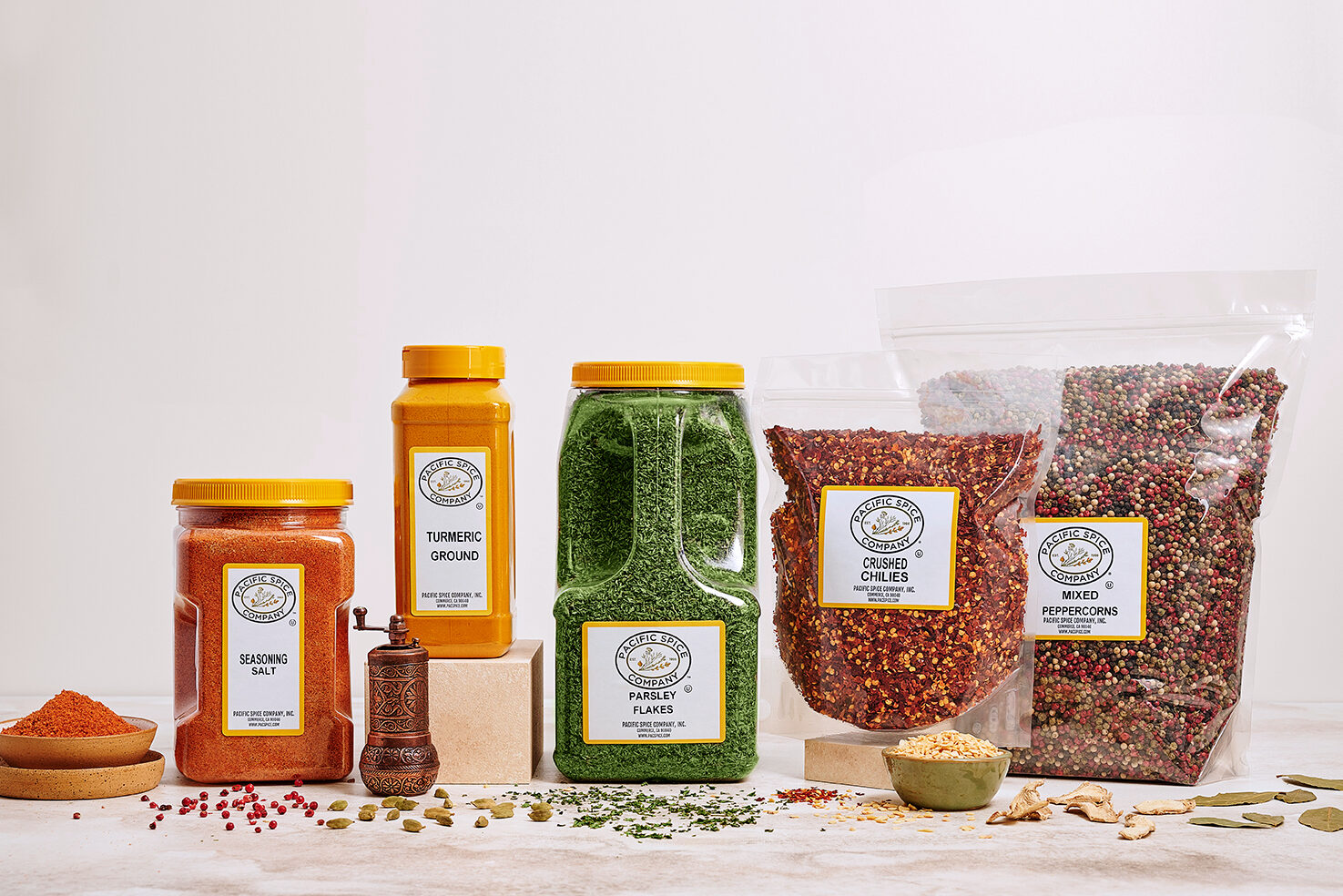
Pacific Spice offers seasoning and spice products in large bulk formats, foodservice jars and premeasured, ready-to-use batch sizes. The right option depends on how much is used, where it is used and what the kitchen team is expected to do with it.
Choosing Foodservice Seasoning Packaging Starts With Use
Before selecting a package, look at the actual kitchen or production process.
Ask:
- Is the seasoning added to a large batch or applied one serving at a time?
- Is it used at a preparation station, on the cook line or in a commissary?
- Does the team measure it by weight, volume or package?
- How many employees handle it?
- How often is the container opened?
- How much storage space is available?
- Is the same product used across several locations?
- Does it move through a distributor?
- Is the seasoning used in one menu item or several?
The best format is the one that makes the approved recipe easier to follow without adding unnecessary handling or measuring.
When Bulk Packaging Makes Sense
Bulk packaging is generally suited to higher-volume operations that already have controlled weighing, batching and storage procedures.
This may include:
- Food manufacturing facilities
- Commissaries
- Central kitchens
- Large institutional operations
- High-volume restaurant groups with centralized production
- Co-packers or processors
Bulk formats give these operations access to a larger quantity of product without requiring several smaller containers. They can be a practical fit when trained employees are already responsible for measuring ingredients into defined production batches.
But the largest package is not automatically the best value.
Before moving to bulk, an operation should consider:
- How the product will be received and stored
- How employees will move and handle it
- Whether weighing equipment is available
- How open product will be protected
- How frequently the seasoning is used
- Whether the operation can manage the product before the end of its shelf life
- How lot identification and inventory will be maintained
Bulk packaging works best when the facility has a clear process for receiving, measuring, storing and tracking the product.
For an operation without those systems, a smaller or premeasured format may be easier to control.
When Foodservice Jars Make Sense
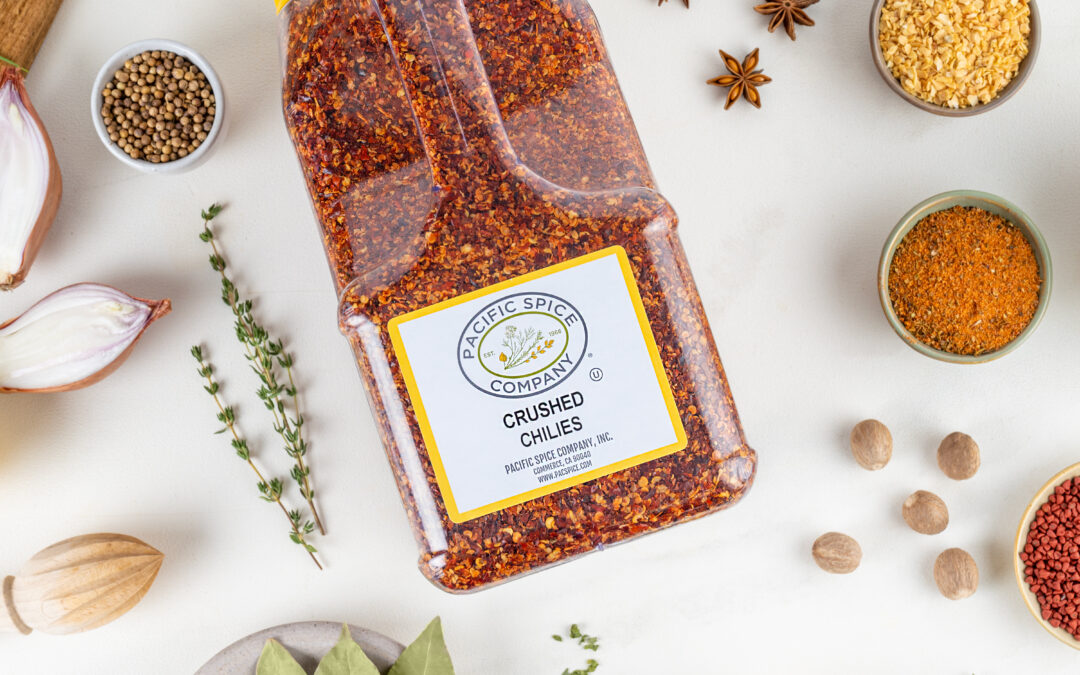
Foodservice jars are often a practical option when the seasoning needs to remain accessible during preparation or service.
They may be appropriate for:
- Cook-line use
- Preparation stations
- Finishing seasonings
- Dry rubs
- Frequently used house seasonings
- Lower-volume locations
- Products applied in smaller increments
A jar allows employees to access the product repeatedly without opening a large bulk package. It can also be easier to store at a station or on a kitchen shelf.
The decision still depends on how the seasoning is applied.
A restaurant should consider:
- How much product the station uses during a shift
- Whether employees scoop, spoon, shake or weigh the seasoning
- How frequently the jar needs to be refilled or replaced
- Where the jar will be stored
- Whether the opening and container design fit the application
- Whether staff members are following a defined portion or applying the product by judgment
A foodservice jar can make a seasoning easier to access, but the package alone does not establish portion control. The operation still needs clear preparation and usage instructions.
When Premeasured Batch Packs Make Sense
Premeasured batch packs are designed around a repeatable unit of use.
Instead of asking each kitchen to measure several ingredients—or measure a larger seasoning container into every recipe—the operation can use a defined pack for a defined batch.
This format may work well for:
- Sauces
- Marinades
- Dressings
- Soups
- Breadings
- Protein preparation
- Commissary recipes
- Multi-unit restaurant systems
- Menu items prepared in repeatable batch sizes
For example, if each location prepares the same quantity of sauce, the seasoning can be packed around that established kitchen batch. The employee follows the preparation instructions and adds the specified pack rather than measuring the seasoning from a larger container.
Depending on the application, this can help:
- Reduce location-level measuring
- Simplify recipe instructions
- Limit variation in how much seasoning enters each batch
- Reduce the number of individual spice ingredients stored in the kitchen
- Make the process easier to train across locations
- Limit how widely a proprietary formula is shared
Premeasured packs are most effective when the operation has a consistent batch size.
If one location prepares five gallons while another prepares two, a single pack size may not fit both processes. The operation may need to standardize the recipe, review its batch sizes or evaluate whether another format is more practical.
Consider the Number of Locations
The package that works for one restaurant may become difficult to manage across a larger network.
An independent restaurant may be comfortable measuring from a foodservice jar. A restaurant group with dozens of locations may want to reduce the number of decisions being made in each kitchen.
As the number of locations grows, consider:
- How the recipe will be trained
- Whether the same equipment is used everywhere
- Whether batch sizes are standardized
- How products are distributed
- How much storage is available at each site
- How frequently each location orders
- Whether the package needs to work across different kitchen layouts
- How changes to the formula or instructions will be communicated
The goal is not necessarily to remove every kitchen decision. It is to identify the decisions that create avoidable variation.
Look at Labor and Training
Every measuring or mixing step requires time and instruction.
When kitchens combine several spices to make one seasoning, employees need to know:
- Which ingredients to use
- How much of each ingredient to measure
- What order to add them
- How to mix them
- How to store the finished blend
- What to do if one component is unavailable
A finished custom blend can consolidate those ingredients. A premeasured batch pack can reduce the measuring required for a repeatable recipe.
That does not eliminate the need for training. Employees still need to know how and when to use the seasoning. But the training can focus on executing the menu item rather than recreating the underlying blend.
Review Storage and Kitchen Space
Foodservice storage is limited, and packaging needs to fit the available space.
A bulk package may reduce the number of individual containers being purchased, but it still requires an appropriate storage area. Several jars may be easier to place near the line but may require more frequent replenishment. Premeasured packs may simplify batch preparation but need to be organized so employees select the correct product and pack size.
Before selecting a format, identify:
- Where unopened product will be stored
- Where opened product will be kept
- Whether the package fits existing shelving
- How the product will be protected during use
- Who is responsible for inventory
- How lots will be rotated
- How frequently the location receives deliveries
Packaging should fit the operation that exists—not an idealized version of the kitchen.
Protecting a Proprietary Formula
For restaurant groups, a signature seasoning may be part of the brand’s identity.
If each kitchen receives every individual ingredient and the complete mixing instructions, more employees may have access to the full formula as the company expands.
A finished custom blend allows locations to receive one seasoning rather than the complete list of components. Premeasured packs may further limit how much information individual kitchens need in order to prepare the menu item.
Packaging is not a substitute for appropriate confidentiality agreements or internal controls. It can, however, reduce how widely a proprietary formula needs to be distributed across the operation.
A Restaurant Group May Need More Than One Format
Not every customer or location uses a seasoning in exactly the same way.
A restaurant group might use a larger format in a central kitchen and a smaller format at individual locations. A product used in both production and finishing may require different handling considerations. A distributor may also need a format that works for several account types.
These situations should be discussed early in the project.
Important questions include:
- Will the formula remain the same in every format?
- Who will use each package?
- How much is used at one time?
- Where is the product being shipped?
- Does each location follow the same recipe?
- Are different pack sizes needed for different customers or kitchen types?
- How will packaging changes affect ordering and inventory?
The answers help determine whether one format can support the entire program or whether the operation needs to evaluate more than one approach.
What to Bring to the Packaging Conversation
Before speaking with a seasoning supplier, gather as much of the following information as possible:
- Menu item or application
- Current recipe or seasoning
- Preparation process
- Current batch size
- Amount of seasoning used per batch
- Number and type of locations
- Current packaging
- Available storage space
- Frequency of use
- Estimated monthly or annual volume
- Distribution method
- Target testing or launch date
- Problems with the current process
Not every detail needs to be finalized before the first conversation. But packaging recommendations are more useful when the supplier understands the kitchen workflow behind the product.
Foodservice Packaging at Pacific Spice
Pacific Spice Company manufactures, blends and packages herbs, spices and seasonings for foodservice companies, restaurant groups and distributors.
Our packaging capabilities range from large bulk formats for industrial use to foodservice jar sizes and premeasured, ready-to-use batch sizes. Our R&D and production teams can also work with customers developing a new seasoning, matching an existing product or moving a kitchen recipe into commercial production.
The right format begins with the operation.
How is the seasoning used? Who handles it? How much enters each batch? How many kitchens need to follow the same process?
Once those questions are answered, the package can be selected to support the product, the people using it and the way the business is expected to grow.